


Station Staff On Air Technology


Audio Equipment


The studio is the heart of the station's operation. Radio Free Burning Man uses a simple set of rules for studio setup: Use whatever equipment can be had, but emphasize reliability, and ease of use.

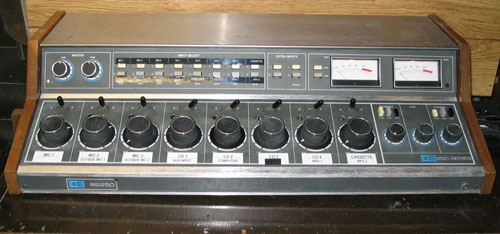
At the center of a conventional broadcast studio is a console. RFBM has used professional broadcast consoles since 1995. In 2001, an RFBM staff member purchased a 1983 Broadcast Electronics 8S250, eight-channel, stereo mixer. This purely analog board has Shallco rotary pots, solid lever switches, hand-soldered interconnect wiring, modular, discrete electronics, and high-velocity VU-meters. The main benefit from professional broadcast consoles is the overall simplicity of the controls. This allows for many user's rapid, lear-as-you-go operation of the station. Professional consoles have similarities between manufactures and present a common interface style to radio DJs that is reasonably easy to master.

Consoles like this one are designed to combine various playback devices and microphones into an audio signal for the transmitter, without additional controls for stereo, tone or effects. Extra controls detract from live radio programming.


We would really appreciate a donated manual for BE 250 series consoles!


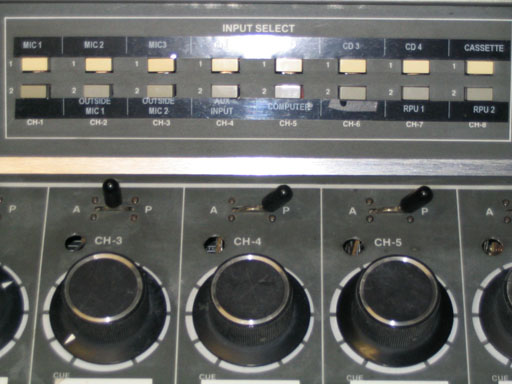
The audio from the playback sources is selected in a push-button matrix called the input select. Each of the eight channels on this console has two inputs, thus multiplying the possible audio sources to sixteen. The inputs are arranged on the input select so that no great portion of input types is lost when another is selected. For instance, when the DJ needs to use the audio from the computer, the input-2 button is pressed on channel five; CD player two is sacrificed, but there are three other CD players to use. The most frequently used inputs are setup on the top row, or input-one for each channel.

The Microphones occupy the first three channels. The DJ's mic is the only one available on channel-one. Mic-2 and -3 are matrixed with the outside mic-1 and -2 inputs. These "outside mics" can be setup for live shows on the verandah. Whenever any of the microphone channels are switched to the program bus, the speaker monitors in the studio are muted automatically to prevent feedback.

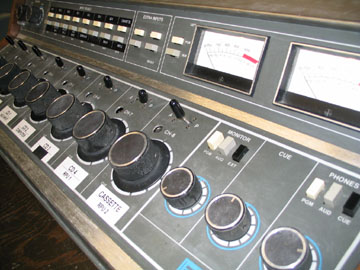
The mix levels for each channel are controlled by eight rotary pots. Some operators need a while getting used to the rotary pots rather than linear faders. Each pot has a detent at its maximum counter-clockwise position which completely mutes the channel from the mix and sends its audio to a cue speaker. Above each channel pot is a lever switch for directing the audio to either the "A" audition bus, the "P" program bus, or centered for channel off. The program bus is the line which will go on the air.

VU meters indicate the audio level on the selected bus. They are set to normally just monitor the "PGM" program bus, but can be switched to "AUD" for a real professional level-setting cue. Audition is tied internally and is not used outside of the console.

There are no remote-start provisions on this console because of lack of a stock, original system for this and also that the playback devices are closer than arm's reach to the operator.


The other equipment includes:

  • 4 Techniques SLPG-100/300/400/450 CD players
  • Quite possibly the best small-studio CD players ever made. The SLPG series has simple controls that respond quickly to operator control, accurate time display, easy time-remain display selection, an auto cue function which stops on the next track, catching the CD between tracks to minimize accidental airing of the next track.

  • 1 Rane HC-6 Headphone Console
  • The HC-6 has six headphone outputs with individual volume controls and enough power to drive stubborn high-quality headphones.

  • 2 Electrovoice RE27N/D microphones
  • These are great microphones with excellent sound, hyper-cardioid rejection of room noise, and they look great.

  • 2 JBL 4313B Control Room Monitors (Speakers)
  • Though smaller than other JBL studio monitors, the -13s pack a good-sized punch and are a nice compliment to our system.


All of this equipment was acquired in used condition and needed attention before placing in service. Design of the studio systems continues each year. An important part of the design philosophy has called for portable and reliable equipment. For the 2002 event, a major rebuild of all the cabling and connections was done to make the new console connect with all the other equipment and improve portability and reliability. The BE 8S250 uses barrier strip terminals for all connections and this does not make for a fast setup or take-down. The rewiring project installed several groups of "pig-tails," or short lengths of cable from the console to XLR connectors. Several custom made cable "snakes" are used between the pig-tails and certain equipment.

All console inputs are configured for balanced lines and allow for shorting to unbalanced at the source end. If a professional piece of equipment replaces a consumer-type, the console is ready for the balanced source.


Audio from this system is via copper pair from studio to transmitter and applied to the stereo inputs of the Orban Optimod 8000A.


HomeStation ∫ Technology ∫ StaffOn Air